

IONIX vs. Cortex Xpanse: Purpose-Built EASM vs. Platform Module


IONIX and Cortex Xpanse take different approaches to external attack surface management (EASM). Xpanse is a module within Palo Alto’s Cortex platform. IONIX is purpose-built for External Exposure Management. That distinction shapes everything: how assets get discovered, whether exposures get validated, and how far the lens extends into subsidiaries and digital supply chains. Organizations evaluating IONIX vs Cortex Xpanse face a structural decision, not a feature checklist.
IONIX vs Cortex Xpanse: capabilities at a glance
| Capability | IONIX | Cortex Xpanse |
|---|---|---|
| Discovery methodology | Organizational entity mapping: subsidiaries, acquisitions, affiliated brands mapped before scanning begins | Internet-wide port scanning: 500B+ ports scanned daily across IPv4 space |
| Exposure validation | Active exploitability testing from an attacker’s perspective, evidence-backed | Asset inventory and CVE correlation; no active validation of exploitability |
| Supply chain coverage | Connective Intelligence traces risk through digital supply chain dependencies | No primary supply chain or third-party dependency coverage |
| Subsidiary risk | Full subsidiary discovery through organizational research | Limited to internet-visible assets; no entity model for unknown subsidiaries |
| Remediation integration | Jira, ServiceNow, Splunk, Slack, plus Active Protection for automatic risk mitigation | Cortex XSOAR playbooks; tightest integration within Cortex ecosystem |
| Stack requirements | Stack-agnostic; works with any security tooling | Delivers most value within Cortex/XSIAM; standalone version has a reduced feature set |
| CTEM alignment | Operationalizes all five Gartner CTEM stages | No explicit CTEM framework alignment |
Discovery methodology: entity mapping vs. port scanning
Cortex Xpanse scans at massive scale. Palo Alto reports scanning 500 billion ports daily across 4.3 billion IPv4 addresses. That breadth catches internet-visible infrastructure. It does not catch assets belonging to entities Xpanse does not know about.
IONIX builds a complete organizational entity model before scanning begins. The platform maps corporate structure, M&A history, brand registrations, and subsidiary relationships. Discovery starts from that verified entity model, not from a seed list of known domains.
The difference is structural. Organizations are aware of roughly 62% of their actual external attack surface. The remaining 38% includes assets from forgotten acquisitions, shadow IT, and subsidiary infrastructure that no one scoped. ASM tools discover 20-40% more assets than security teams knew existed, according to CybelAngel’s research on attack surface blind spots. Port scanning finds what is visible on the internet. Organizational entity mapping finds what belongs to you, including assets you forgot you owned.
An attacker researching a target does not limit reconnaissance to a primary domain. Attackers enumerate subsidiaries, identify recently acquired companies, and probe the weakest link. IONIX mirrors that approach: the organizational entity map captures the full corporate footprint before a single port gets scanned. Xpanse starts scanning without that organizational picture.
Exposure validation: evidence-backed findings vs. asset lists
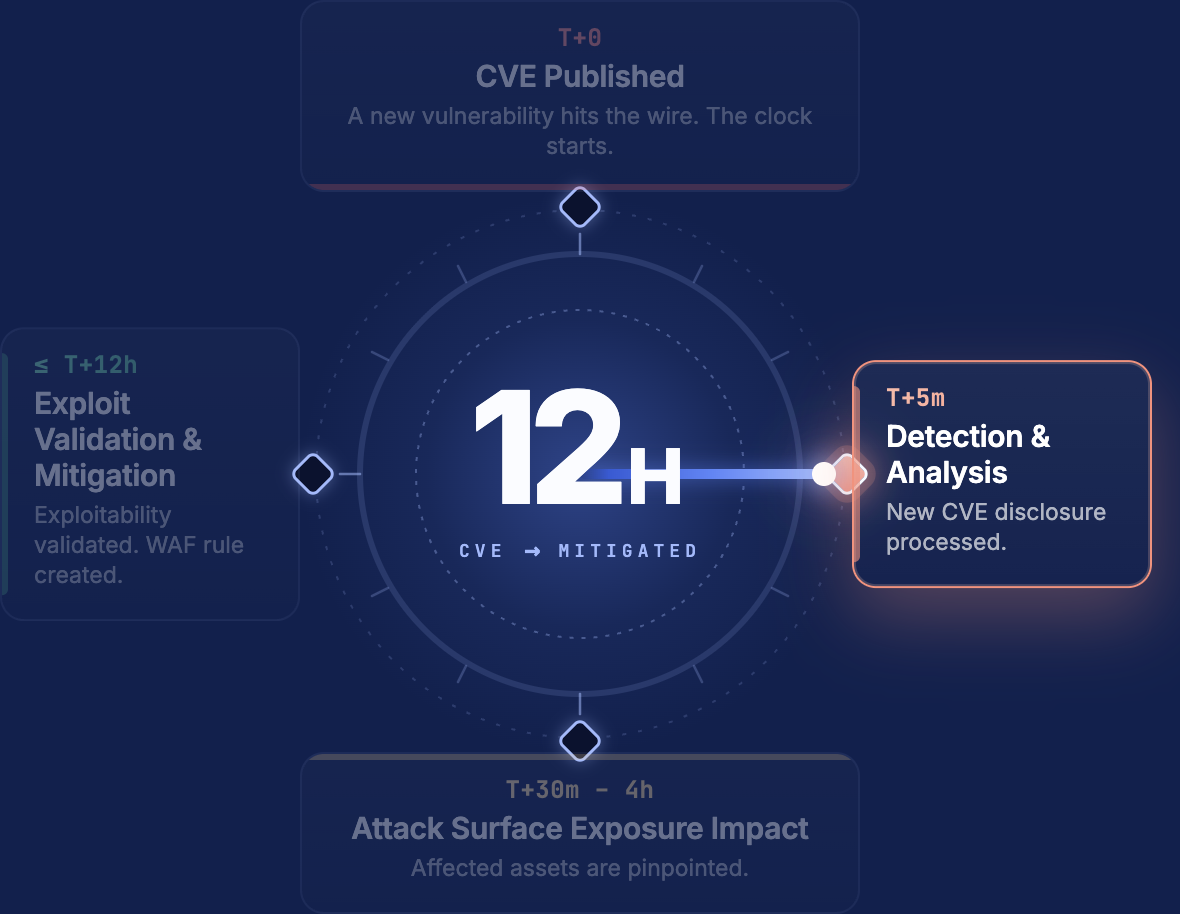
Discovery without validation produces a longer worry list. Nearly 40,000 CVEs were disclosed in 2024, and attackers exploit new CVEs within hours of disclosure. Correlating CVEs against discovered services tells you what could be vulnerable. It does not tell you what an attacker can reach and exploit.
IONIX performs active exposure validation: testing discovered assets from the outside, the way an attacker would, to confirm whether a vulnerability is reachable and exploitable. The platform delivers validated findings with evidence of real-world exploitability, not theoretical risk scores.
Palo Alto does not lead with validation in Xpanse messaging. According to Palo Alto’s 2024 SEC filing, Cortex Xpanse “provides ASM, which is the ability for an organization to identify what an attacker would see among all of its sanctioned and unsanctioned Internet-facing assets.” The emphasis is on identification. IONIX goes further: identification, then active validation of exploitability, then prioritized remediation.
IONIX customers report a 97% drop in false-positive alerts after switching from discovery-only tools. Mean time to resolve external exposures drops by up to 90%. A Fortune 500 organization reduced MTTR by over 80% within six months. Those outcomes come from eliminating noise and focusing security teams on exposures that attackers can reach.
Supply chain and subsidiary exposure: the gap Xpanse does not address
50% to 60% of cyberattacks are perpetrated via third parties, according to IONIX. Attackers target the weakest entity connected to an organization’s digital infrastructure, not the primary domain with the largest security budget.
IONIX’s Connective Intelligence maps and monitors digital supply chain dependencies, infrastructure connections, and third-party assets linked to your organization. The platform traces how a vulnerability in a vendor-managed asset or a subsidiary’s infrastructure creates risk for the parent organization. Security teams see the full exposure picture: direct assets, subsidiary assets, and supply chain dependencies.
Cortex Xpanse does not offer primary supply chain or third-party dependency coverage. CSO Online’s 2025 review of EASM tools notes that Xpanse “has been tightly integrated into the Palo Alto universe of XSOAR and other XSIAM modules” but frames its capabilities around discovery, playbook automations, and dashboards. Supply chain risk tracing is absent from the product’s positioning.
For multi-entity enterprises with subsidiaries across regions, acquired companies still running legacy infrastructure, and vendor-managed services scattered across providers, supply chain and subsidiary coverage separates the tools that show you ports from the tools that show you organizational risk.
Stack independence vs. Cortex dependency
IONIX integrates with Jira, ServiceNow, Slack, Splunk, Microsoft Sentinel, and Palo Alto’s own Cortex/Demisto SOAR platform. The IONIX platform whitepaper describes a comprehensive API framework that fits into any existing security stack. Remediation workflows, ticket routing, and SIEM enrichment work regardless of which vendors fill the rest of your architecture.
Cortex Xpanse delivers most value within the Cortex ecosystem. Palo Alto’s SEC filing describes Xpanse as available “as a stand-alone cloud-based service and a cloud-based subscription module within Cortex XSIAM,” with a “slightly smaller feature set on the standalone product,” per CSO Online. Organizations running mixed or non-Palo Alto stacks face a trade-off: adopt the module and accept Cortex dependency, or use the standalone version with fewer capabilities.
A purpose-built External Exposure Management platform has no vendor allegiance to protect. IONIX serves attack surface owners and vulnerability management leaders who need results in their existing workflows, not a migration to a new platform vendor’s ecosystem.
Xpanse strengths: scale and enterprise relationships
Xpanse brings real advantages that deserve acknowledgment.
Palo Alto has deep enterprise relationships. For organizations already running Cortex XDR, XSIAM, or XSOAR, adding Xpanse requires no new vendor evaluation. Procurement teams and CISOs consolidating their stack around Cortex can activate Xpanse as an additional module. That convenience matters in budget cycles where adding a new vendor faces institutional resistance.
The 500 billion daily port scan volume is impressive coverage breadth. All six branches of the U.S. military use Xpanse for internet-facing asset visibility, which demonstrates the platform’s scale credentials.
The reframe: port volume is not the constraint most security teams face. Knowing which of those ports belong to a subsidiary you did not scope, and whether the exposure behind them is exploitable, is the constraint. Xpanse gives you a list of what exists on the internet. IONIX tells you what belongs to your organization, confirms whether it is exploitable, and maps the risk through your subsidiaries and supply chain. The problems are different. The architectures that solve them are different.
Cortex XDR 5.0’s “Unified Exposure Management” claim
Palo Alto launched Cortex XDR 5.0 in early March 2026 with a “Unified Exposure Management” add-on. The positioning claims to “eliminate the need for standalone EASM tools.”
An XDR add-on that bolts on external scan data does not replace an external-first platform built on organizational research, active exploitability validation, and supply chain mapping. Xpanse does not build a complete entity model of your subsidiaries before scanning. It does not validate which discovered exposures are exploitable from the outside. It does not trace risk through third-party infrastructure dependencies.
Those are the gaps where breaches start. Adding Xpanse scan data to an XDR console gives Cortex users visibility into internet-facing assets. Visibility without validation, without organizational entity mapping, and without supply chain context leaves the hardest problems unsolved.
The consolidation pitch targets CISOs looking to reduce vendor count. The security operations reality is that external exposure requires purpose-built capabilities: research-driven discovery, continuous exploitability testing, and organizational scope that extends to every entity an attacker would target. Bolting those capabilities onto an endpoint detection platform has not changed the underlying architecture.
IONIX operationalizes Validated CTEM
Gartner predicts that by 2026, organizations prioritizing security investments based on a Continuous Threat Exposure Management (CTEM) program will be three times less likely to suffer a breach. The CTEM framework, first introduced by Gartner in 2022, defines five stages: scoping, discovery, prioritization, validation, and mobilization.
IONIX operationalizes all five. The organizational entity map defines scope. Continuous discovery identifies assets across the full corporate structure. Evidence-backed prioritization ranks exposures by real-world exploitability and blast radius. Active validation confirms which exposures an attacker can reach. Integrated remediation workflows mobilize the right teams with clear action items. IONIX was honored as a CTEM finalist in the 2025 SC Awards, recognizing this alignment.
Cortex Xpanse addresses discovery. The remaining four CTEM stages, scoping through organizational research, validated prioritization, exploitability testing, and remediation mobilization, require capabilities Xpanse’s architecture does not provide. For security leaders building a Validated CTEM program, the platform choice determines how many stages your tooling covers.
Security teams evaluating IONIX vs Cortex Xpanse should book a demo to see how organizational entity mapping, exposure validation, and Connective Intelligence address the exposures that platform modules miss.
FAQs
Cortex Xpanse is available both ways: as a standalone cloud service and as a module within Cortex XSIAM. The standalone version has a smaller feature set. Xpanse delivers full functionality within the Cortex ecosystem, making it best suited for organizations already invested in Palo Alto’s platform.
Xpanse identifies internet-facing assets and correlates known CVEs against discovered services. It does not perform active exploitability testing from an attacker’s perspective. IONIX validates exposures with evidence-backed, external-first testing that confirms real-world exploitability before generating an alert.
IONIX integrates with Jira, ServiceNow, Splunk, Slack, Microsoft Sentinel, and other tools through a comprehensive API framework. The platform is stack-agnostic and delivers full functionality regardless of which vendors fill your security architecture.
Internet-wide port scanning finds every service visible on the internet and attempts to attribute assets to organizations. Organizational entity mapping builds a verified model of corporate structure, subsidiaries, acquisitions, and brand registrations before scanning begins. Entity mapping catches assets belonging to entities that port scanning would never attribute to your organization.
Cortex XDR 5.0 adds Xpanse scan data to the XDR console. It does not add organizational entity mapping, active exploitability validation, or supply chain dependency tracing. External exposure management requires research-driven discovery and continuous validation that an XDR add-on does not provide.